Short answer
Persian rice dishes are called polo when the rice is cooked with other ingredients, such as herbs, sour cherries, barberries, lentils or green beans. Each polo is traditionally paired with a particular meat, such as chicken, lamb or fish.
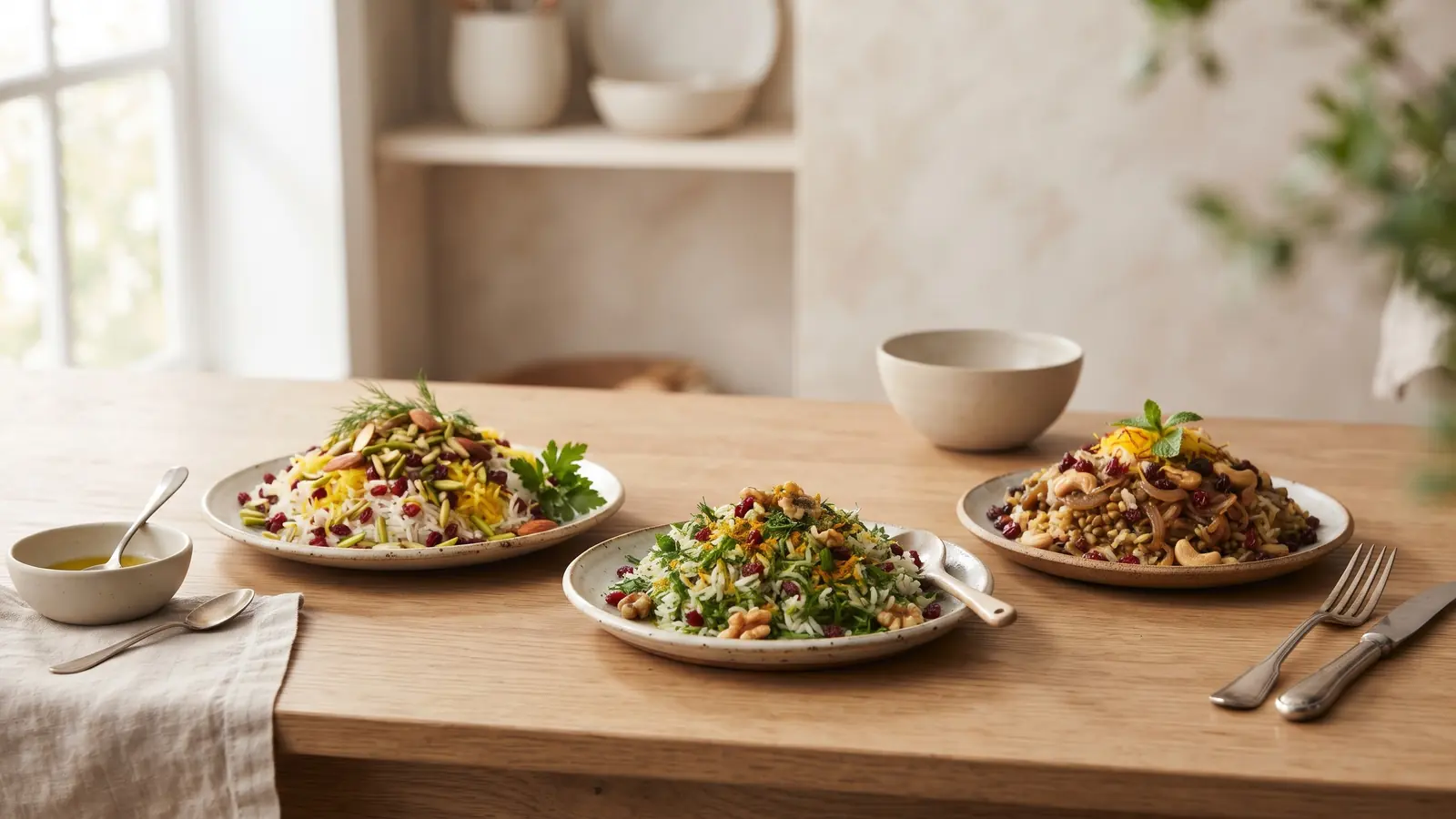
Persian rice dishes are mostly polo, a mixed rice in which the grains are cooked or layered with herbs, fruit, beans or meat. The best known are sabzi polo with herbs, zereshk polo with barberries, albaloo polo with sour cherries and adas polo with lentils and dates.
What is polo in Persian cooking?
Polo is the Persian word for rice that is cooked with other ingredients, and it is the same word that gave pilaf and pilau in other languages. It is distinct from chelo, which is plain steamed rice.
A pot of polo is made by parboiling long-grain basmati, then layering it in the pot with the ingredients and steaming it so the flavors move through the rice. The base technique is the same as for chelo, which is covered in a separate guide on Persian rice. Polo is often served at gatherings and holidays.
What are the main types of Persian polo?
The main polo are sabzi polo, zereshk polo, albaloo polo, baghali polo, adas polo, loobia polo and shirin polo. Each one has a signature ingredient.
| Polo | Signature ingredients | Taste | Usual pairing |
|---|---|---|---|
| Sabzi polo | Parsley, dill, cilantro, chives | Herbal | Fried fish |
| Zereshk polo | Barberries, saffron | Tart, sweet | Saffron chicken |
| Albaloo polo | Sour cherries, sugar | Sweet and sour | Chicken or meatballs |
| Baghali polo | Fava beans, dill | Green, fresh | Lamb shank |
| Adas polo | Lentils, raisins, dates | Sweet, earthy | Kabob or chicken |
| Loobia polo | Green beans, tomato, ground meat | Savory | Plain, with yogurt |
| Shirin polo | Orange peel, almonds, pistachios | Sweet, fragrant | Chicken |
What is sabzi polo?
Sabzi polo is rice mixed with a large amount of chopped fresh herbs, mainly parsley, dill, cilantro and chives, sometimes with fenugreek. It is the traditional dish for Nowruz, the Persian new year.
The herbs are layered with parboiled rice so the steam carries their aroma. The rice turns green flecked and fragrant. It is usually served with fried white fish, called mahi, and a plate of fresh herbs on the side.
What is zereshk polo?
Zereshk polo is rice topped with sauteed dried barberries and saffron, and it is usually served with chicken that has been cooked in saffron and onion. Zereshk is the Persian word for barberry.
Dried barberries are rinsed to remove grit, then briefly sauteed in butter with a spoonful of sugar so they stay glossy. The sugar softens their sharp taste. A common version called zereshk polo ba morgh pairs the rice with a bone-in chicken piece cooked in saffron sauce. Persian grocers sell barberries in bags.
What is albaloo polo?
Albaloo polo is rice layered with sour cherries cooked in sugar, with saffron and sometimes cinnamon, and it tastes sweet and tart in turn. Albaloo is the Persian word for sour cherry.
The cherries are simmered with sugar until syrupy and tucked among the rice layers. Meat is often cooked into the dish as small meatballs or pieces of chicken. The dish is a celebration meal, and the contrast of sweet and savory is typical of Persian cooking.
What are baghali polo and adas polo?
Baghali polo is rice cooked with fava beans and dill, while adas polo is rice with brown lentils, raisins and dates. Both are hearty rices that suit cooler months.
- Baghali polo: shelled fava beans, fresh or dried dill, served with lamb shank, called baghali polo ba mahicheh.
- Adas polo: cooked lentils, caramelized onion, raisins or dates, a little cinnamon, often with a topping of saffron.
Both can be vegetarian without the meat. Many families make adas polo with ground meat or kabob on the side.
What are the other mixed rices?
Other mixed rices include loobia polo with green beans, shevid polo with dill, tahchin as a baked cake and kateh as a simple one-pot rice. Regional kitchens add their own versions.
Loobia polo has green beans, tomato paste and sometimes ground meat cooked into the rice. Tahchin is a baked cake of rice, yogurt, egg and saffron, with chicken in the middle. Kateh is a Gilani-style rice cooked in measured water, served with butter, cheese or an egg.
How do you serve Persian rice dishes?
Persian rice dishes are served on a large platter with a piece of tahdig, a spoon of saffron rice on top and a side of yogurt, herbs or salad. The meat is placed beside the rice or on it.
A typical table has the polo, a protein, torshi pickles, mast-o-khiar yogurt and fresh herbs. Sumac and butter are offered at the table. Drinks are usually doogh or black tea.
Which polo suits which occasion?
Polo are matched to seasons and holidays: sabzi polo for Nowruz, albaloo polo for celebrations and adas polo for cooler months. The pairings are customs, not rules, and they differ between families.
- Nowruz (new year): sabzi polo with fish is the traditional spring meal.
- Weddings and parties: zereshk polo and shirin polo are common, since they are colorful and fragrant.
- Everyday meals: loobia polo and kateh are quick and filling.
- Winter: baghali polo with lamb and adas polo are warm and substantial.
How do you cook a polo step by step?
A polo is cooked by parboiling the rice, layering it with the main ingredient in an oiled pot, and steaming it for about 40 minutes. The layering lets the steam carry the flavors.
- Soak and parboil the basmati rice for about six minutes, then drain.
- Oil the bottom of the pot and add a thin layer of plain rice for the tahdig.
- Alternate layers of rice and the herbs, beans or fruit, mounding toward the center.
- Poke holes through the pile to let steam rise.
- Cover with a towel-wrapped lid and steam on low heat for 35 to 45 minutes.
- Mix a little rice with saffron water, then plate the polo with the saffron rice on top.
What does the Oskoo market guide record about Persian rice?
Oskoo Persian & Mediterranean Market in Bellevue is a grocery store, not a restaurant, so it is not listed as selling prepared polo. Atly describes it as selling Persian, Turkish and Mediterranean foods, including fresh bread, pastries and spices.
Yelp reviewers mention Persian groceries and rice cookers. The guide has no product list, so it cannot say whether barberries, dried cherries or basmati are in stock. Call (425) 746-3061 to ask, and use the hours and location page and the FAQ for practical details. This guide is independent and takes no orders.
Common questions
What is the difference between polo and chelo?
Chelo is plain steamed rice, served under stews and kabobs. Polo is rice mixed or layered with other ingredients, such as herbs, fruit, beans or meat, and is served as a complete dish with its own pairing.
What is the most popular Persian rice dish?
Zereshk polo ba morgh, barberry rice with saffron chicken, is among the best known, along with baghali polo and sabzi polo. Popularity varies by region and family, and there is no single official ranking.
What are barberries?
Barberries are small tart red berries sold dried in Persian stores. They are rinsed, sauteed briefly with sugar and scattered over rice. They taste similar to a mild cranberry and bring sour contrast.
Is tahchin a type of polo?
Tahchin is a baked rice cake made with rice, yogurt, egg and saffron, often with chicken inside. It is related to polo but cooked in an oven and cut into squares like a savory cake.
Can polo be made ahead?
Yes. Most polo reheat well in a covered pot with a splash of water or steamed again for a few minutes. The tahdig is best fresh, but leftover rice also keeps for several days refrigerated.
For the address, opening hours and menu, see Oskoo Persian & Mediterranean Market in Bellevue.
This article is general information from an independent guide, not from Oskoo Persian & Mediterranean Market itself. For the store’s current details see hours and location.